
Points Systems Explained
Field-Weighted, Fixed, and Classic. How each one scores a night, worked through with real numbers, and an honest opinion on which one your game should use.
There are three points systems. This chapter explains what each one actually does, works one night of poker through all three so you can see the difference in real numbers, and then tells you which one to pick.
Picking a Points System applies a whole preset. It does not just change the scoring formula: it also sets the season length, the minimum games, the season pot, the qualifiers, the bonuses, and the finale. Your season name, dates, and buy-in are preserved. So choose your system first, then adjust the details.
Field-Weighted
The default, and the one most leagues should use.
Your points are how many players you beat, plus one. In a 10-player game, first gets 10, second gets 9, and last gets 1. In a 6-player game, first gets 6.
That is the whole system. It is trivial to explain at the table, which matters more than people think, and it has one important property: a win in a big field is worth more than a win in a small one. Beating 19 people should count for more than beating 5, and here it does, automatically.
Everyone who turns up scores something. Nobody goes home with zero.
Fixed
A fixed points-per-place chart. Same points every night, regardless of turnout.
Out of the box: 10, 7, 5, 4, 3, 2, 1 for the first seven places. Everyone below seventh scores zero.
The chart is yours to change (Premium), so you can make it as steep or as flat as you like.
The thing to understand is what “fixed” costs you: a 6-player night pays first place the same 10 points as a 20-player night. If your attendance swings around a lot, this quietly rewards the guy who only turns up on quiet weeks, where the win is easier.
That is not automatically wrong. If your game is a stable 9 or 10 players every single week, field size is not really varying, and a fixed chart is clean and predictable. But if your turnout is lumpy, you are building a bias into your season.
Classic (Final Table Classic)
The richest of the three, and the one this app was really built for. It is a real league’s scoring model, run for years, ported wholesale.
Classic is Field-Weighted plus four extra layers:
- Place points, exactly as Field-Weighted (players beaten, plus one).
- 1 point per knockout. Bust someone, get a point. This rewards aggression.
- Medals: 5 / 3 / 1 for first, second, and third, respectively. A podium finish is worth more than the place points alone suggest.
- A last-place penalty of −1 (the First One Out, or “FOO”). Finish dead last and you lose a point.
And it ranks players by RankPoints rather than raw points, which is the part that needs explaining.
RankPoints: rewarding quality over quantity
This is a toggle labeled “Reward Strong Finishes Over Volume”, and it is available under Field-Weighted (Classic switches it on for you automatically).
Here is the problem it solves. In a normal cumulative season, the way to win is to show up every week. A mediocre player with perfect attendance will beat a strong player who misses four nights, because points only accumulate. For a lot of leagues that is fine, and even desirable: attendance is what you want to reward.
But some leagues want the season won by whoever actually played best. That is RankPoints.
It multiplies your points by your average efficiency: the share of the points that were available to you which you actually took.
RankPoints = (Base Points × Average Score) + Medal Points
Base Points = your place points + your knockout points
Average Score = Base Points / Max Points Available
Medal Points are your podium bonuses and any FOO penalties.
Max Points Available is the most you could have scored, which is the field size: you only score the full 15 in a 15-player game by winning it. Add up the field sizes of the games you played and that is your ceiling. It is not the pool of points shared out across the table (15 + 14 + … + 1 = 120). RankPoints asks what share of your own maximum you took, not what share of the room’s points you took.
Example: you play one week, finish 3rd against a 15-player field, and knock out 1 player.
Your Place Points = 13 (you beat 12 players, plus one)
Your Knockout Points = 1
Your Base Points = 14 (13 + 1)
Max Points Available = 15 (the field size)
Your Average Score = 0.933 (14 / 15)
Your Medal Points = 1 (bronze)RankPoints = (14 × 0.933) + 1 = 14.07
One quirk falls out of the ceiling being the field size: your average score can go above 1.00. Knockout points are added to your base, but they do not raise the ceiling. Bust enough players and you can score more than the field alone was worth. In the standings below, Bob’s average score is 1.25. That is working as intended, not a rounding error.
The medals are deliberately left out of the multiplied part and added once at the end. Only your place and knockout points get scaled by how efficiently you played; a podium bonus is a flat reward for the podium itself.
In plain terms: turning up does not help you unless you do well when you turn up. A player who plays 6 games and finishes near the top of every one can beat a player who plays 20 games and finishes mid-pack in all of them.
Use it if you want your champion to be the best player. Leave it off if you want your champion to be the most committed player.
Both are legitimate ways to run a league. They are just different leagues.
Three games, scored three ways
A single night cannot show you what these points systems really do, because the difference between them is a season. And it has to be a season with different-sized fields, because that is the thing the point systems actually disagree about.
So: three games, and turnout that swings the way real turnout swings.
| Game 1 | Game 2 | Game 3 | |
|---|---|---|---|
| Turnout | 16 players (a big night) | 8 players (a quiet night) | 12 players |
| Winner | Ann | Bob | Cal |
| The podium | Ann, Nia, Cal | Bob, Ann, Cal | Cal, Ann, Sam |
| Mid-pack | Dee, Rex (5th), Tom (6th), Eve, Fay… | Dee, Rex (5th), Tom (6th), Eve, Fay | Dee, Rex (5th), Eve, Fay, Gil… |
Ann, Cal, and Dee are the regulars who play every week. Five other players carry the whole lesson:
- Bob turns up once, on the quiet 8-player night, and wins it.
- Nia turns up once, on the big 16-player night, and finishes 2nd.
- Sam turns up once, on the 12-player night, and finishes 3rd.
- Tom turns up twice, finishing 6th of 16 and then 6th of 8.
- Rex turns up to all three and finishes 5th every time.
What a win is worth
Start with the winners, because this is the clearest thing in the chapter.
| The win | Field-Weighted | Fixed |
|---|---|---|
| Ann wins a 16-player game | 16 | 10 |
| Cal wins a 12-player game | 12 | 10 |
| Bob wins an 8-player game | 8 | 10 |
Field-Weighted says Ann’s win was worth twice Bob’s, because she beat fifteen people and he beat seven. Fixed says all three wins were identical. That is not a subtle difference. It’s the entire reason to prefer one system over the other, and it only becomes visible when your turnout moves.
If your game really is nine or ten players every week, this table collapses and Fixed is harmless. If it swings between eight and sixteen, Fixed is quietly paying a premium for winning on the quiet nights.
Showing up versus doing well: Sam and Tom
Now the second question a points system has to answer: is it better to play once and do well, or several times and do all right?
On raw place points, Tom is ahead. He scored 11 (6th of 16) plus 3 (6th of 8) for 14. Sam scored 10 (3rd of 12) on his single night. Under Field-Weighted, Tom outranks Sam, and the attendance wins.
On RankPoints, Sam is ahead. He took 10 of the 12 points available to him, an average score of 0.833. Tom took 14 of a possible 24, an average of 0.583. So Sam scores 10 × 0.833 = 8.33, plus a bronze medal, for 9.33. Tom scores 14 × 0.583 = 8.17.
Turning up twice and finishing mid-pack was worth less than turning up once and reaching the podium. Under RankPoints, quality is rewarded over quantity.
The steady grinder versus the one brilliant night: Rex and Nia
The third question is the one that separates Fixed from RankPoints, and it is the subtlest of the three.
Rex is the model league member. He plays all three nights and finishes 5th every single time. Nia plays once, on the biggest night of the season, and finishes 2nd.
| Rex (5th, 5th, 5th) | Nia (2nd of 16) | |
|---|---|---|
| Fixed | 3 + 3 + 3 = 9 | 7 |
| RankPoints | 16.00 | 17.06 |
Fixed puts Rex ahead. Its chart pays 3 points for 5th, every night, regardless of whether five people turned up or fifty. Three appearances at 5th simply out-earn one appearance at 2nd. Fixed cannot see that Nia’s 2nd place came in a field twice the size.
RankPoints puts Nia ahead. She took 15 of the 16 points available to her, an average score of 0.938. Rex took 24 of a possible 36, an average of 0.667. Nia’s single night was close to flawless; Rex’s three were solidly unremarkable.
This is the pair to argue about, because neither answer is obviously right. Rex is the guy who makes your league exist. Nia turned up once and played better poker than he did all season. Which of those two do you want to be your champion? That is not a maths question, and the app will not decide it for you.
The season standings
Here is everyone after the three games. Sorted by RankPoints, which is how Classic ranks a season. The other two columns show what the same poker would have scored under the other two systems. The five players above are highlighted.
Click any column header to re-sort. It is the fastest way to see how differently these systems rank the same three nights.
| Player | Games Played | Rank Points | Field-Weighted Points | Fixed Points |
|---|---|---|---|---|
| Ann | 3 | 51.11 | 34 | 24 |
| Cal | 3 | 41.03 | 32 | 20 |
| Dee | 3 | 20.25 | 27 | 12 |
| Bob | 1 | 17.50 | 8 | 10 |
| Nia | 1 | 17.06 | 15 | 7 |
| Rex | 3 | 16.00 | 24 | 9 |
| Eve | 3 | 10.03 | 19 | 4 |
| Sam | 1 | 9.33 | 10 | 5 |
| Tom | 2 | 8.17 | 14 | 4 |
| Fay | 3 | 6.11 | 16 | 1 |
| Gil | 2 | 6.04 | 13 | 0 |
| Hal | 2 | 4.32 | 11 | 0 |
| Ivy | 2 | 2.89 | 9 | 0 |
| Jon | 2 | 1.75 | 7 | 0 |
| Kim | 1 | 1.00 | 4 | 0 |
| Moe | 1 | 0.25 | 2 | 0 |
| Lee | 2 | -0.43 | 4 | 0 |
| Pat | 1 | -0.94 | 1 | 0 |
Sort by each column in turn. The five highlighted players land somewhere different every time, and none of the three orders agree:
| Rank Points | Field-Weighted | Fixed | |
|---|---|---|---|
| Bob (won the quiet night) | 4th | 13th | 4th |
| Nia (one great night) | 5th | 7th | 6th |
| Rex (5th, three times) | 6th | 4th | 5th |
| Sam (one podium) | 8th | 11th | 7th |
| Tom (twice, mid-pack) | 9th | 8th | 8th |
Bob is the most extreme case: 4th under Fixed and RankPoints, but 13th of 18 under Field-Weighted. He won a game, which Fixed rewards flatly and RankPoints rewards as perfect efficiency, but he only ever beat seven people, which is all Field-Weighted cares about.
And notice Rex and Nia trade places depending on the column, which is the one comparison Field-Weighted and Fixed cannot help you with. Only RankPoints is asking “how well did you play, relative to what was in front of you.”
A few more things worth pausing on:
- Fixed throws information away. Nine of the eighteen players score zero, because the default chart only pays the top seven. Gil, Hal, Ivy, and Jon all played multiple nights and have nothing whatever to show for it. Their order in the standings is decided entirely by tiebreakers, not by points.
- The bottom can go negative. Pat busted last in the 16-player game and finishes on −0.94, because the −1 FOO penalty is applied flat, after his single place point has been scaled down by a dismal average.
- Medals are added, not multiplied. Sam’s 9.33 is 10 × 0.833 = 8.33, then + 1 for the bronze.
The very top barely moves. Ann and Cal are the best players and the most regular, so all three systems agree they lead. These systems only really disagree in the middle, where the committed and the talented get mixed together. That middle is where league arguments actually happen.
So which one should you use?
Use Classic if you want the league to be the point. If your players talk about the standings, if there is a champion at the end who gets bragging rights for a year, if you want a season with a narrative: use Classic. The knockout points and medals make every night feel like it mattered, and the FOO penalty gives the whole table someone to laugh at. It is the most fun, and fun is the actual product here.
Use Field-Weighted if you want it simple. If you just want a leaderboard without explaining a formula to anybody, this is it. It is fair, it handles varying turnout correctly, and you can describe it in one sentence. This is the safe default and there is no shame in it.
Use Fixed only if you have a specific reason. If you already run a points chart your players know and expect, put that chart in. Otherwise, be honest about the trade: your attendance swings, and a fixed chart pretends it does not.
And on RankPoints: switch it on if your league is competitive and people miss weeks for legitimate reasons. Leave it off if attendance is the thing you are trying to encourage. If you are not sure, leave it off. It is easier to explain a leaderboard where the points just add up.
Customizing the scoring
Premium only. Paid users see all of these controls, in place, but read-only, with an “Upgrade to Premium to customize scoring” note. Nothing is hidden from you; you just cannot change it.
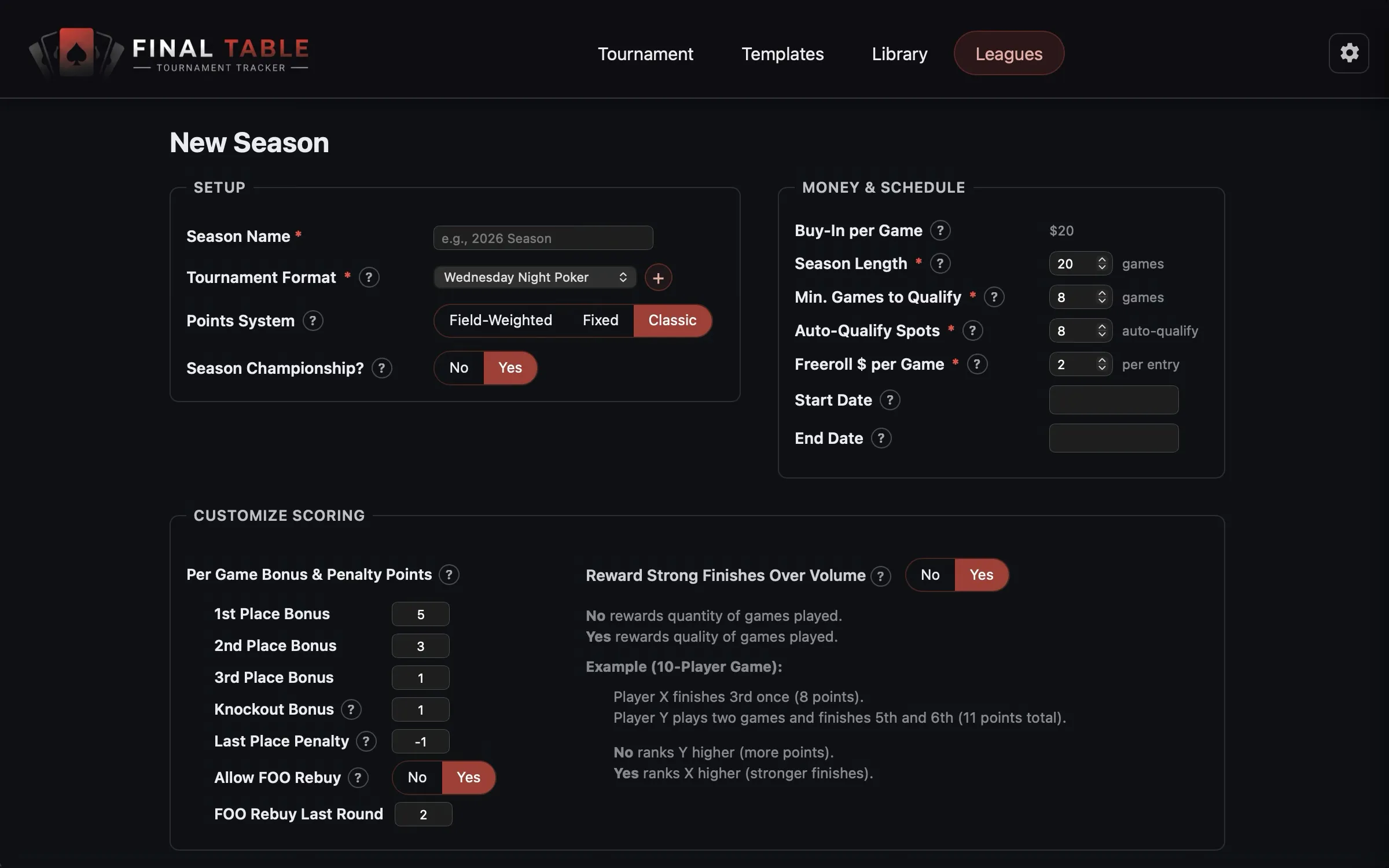 Every scoring dial. Premium can change them; Paid can see them.
| Setting | What it does |
|---|---|
| 1st / 2nd / 3rd Place Bonus | Medal points on top of place points. Classic uses 5 / 3 / 1. |
| Knockout Bonus | Points per player you bust. Classic uses 1. |
| Last Place Penalty | Negative points for finishing last. Classic uses −1. |
| Points per Place | The chart, in Fixed mode only. |
| Reward Strong Finishes Over Volume | RankPoints, in Field-Weighted mode only. |
| Allow FOO Rebuy | See the warning below. |
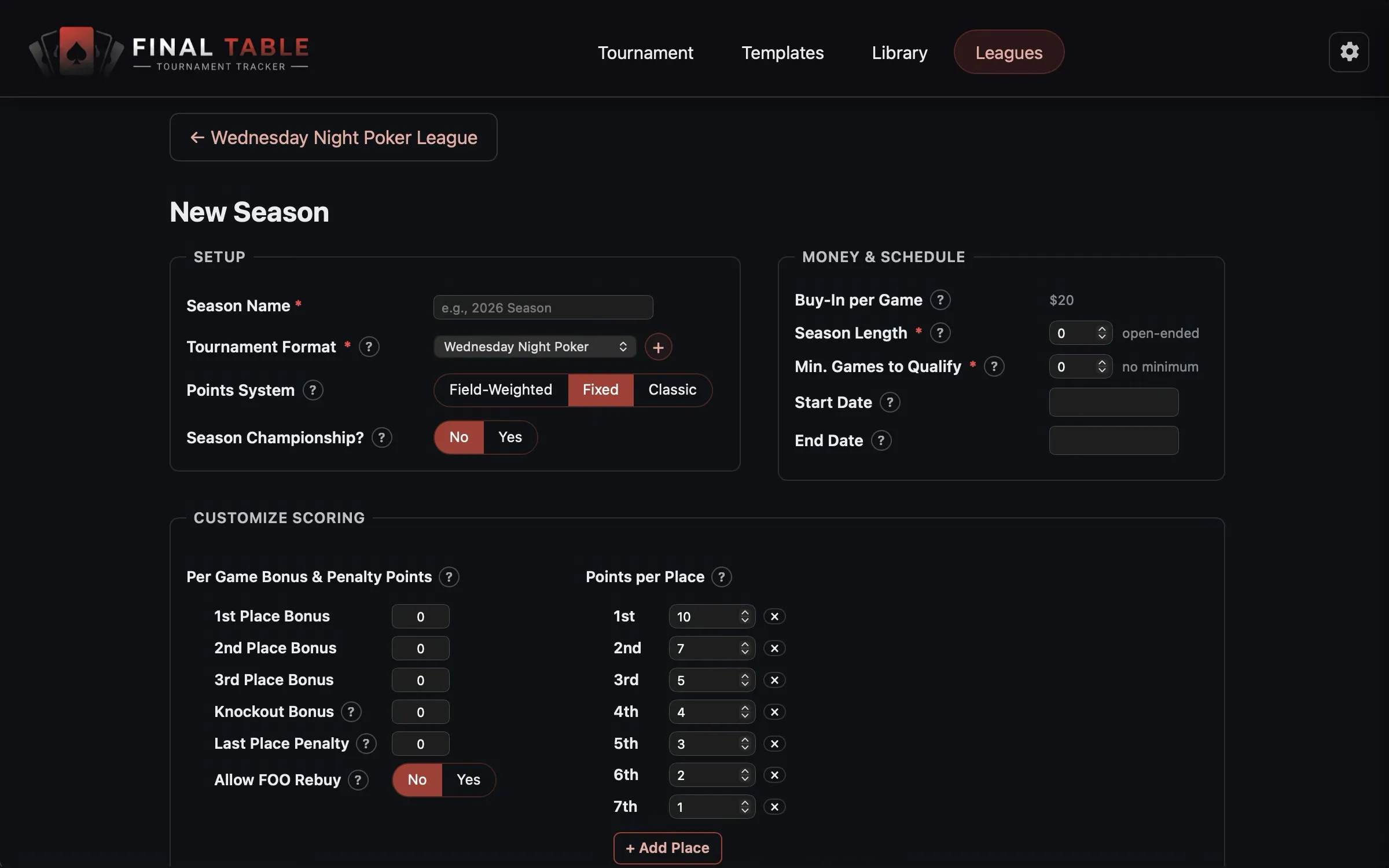 Fixed mode gives you the points chart to edit.
The First One Out (“FOO”) Rebuy, and its one gotcha
Allow FOO Rebuy lets the first player out buy back in, through a round you choose (Classic: round 2). It is a nice piece of league design. Busting first is miserable, and this gives that one person a second life.
But read this carefully, because it is the single most surprising setting in the app:
Turning on FOO Rebuy overrides the tournament format’s own rebuy and re-entry settings. The night runs as a freezeout in which only the FOO can buy back in.
So if your league format allows rebuys for everyone, and you also switch on FOO Rebuy, the general rebuys stop happening. That is the intended design (it is what makes the FOO rebuy special rather than routine), but it will absolutely catch you out if you do not know.
Pick one model: an open rebuy night or a freezeout with a FOO mercy rule. Not both.
What the FOO rebuy actually buys
The second life plays for money, not for league points. This is the whole idea, and it is worth saying out loud at the table before anyone buys back in.
The rebuy is a real entry. It pays into the pot, it sits at the table, and it can go all the way and cash. If the FOO buys back in and finishes 2nd in the money, they get paid 2nd.
For the season, none of that happens:
- Their league finish stays last. However far the rebuy runs, the season records them as the first player out, because that is what they were.
- Knockouts they make on the rebuy life score no league points. They still count toward the player’s lifetime knockout stat, but they are worth nothing in the standings.
- So in Classic they net 0 for the night: the one last-place point, minus the −1 FOO penalty.
The knockouts only stop scoring in one direction. Anyone who busts the FOO’s second life gets a full league KO point for it. The rebuy is a live target for everybody else; it simply cannot score for the player sitting behind it.
Three things to remember:
- Nobody gets promoted. The FOO does not vacate a spot. If they finish 4th, the player who finished 5th is still 5th in the standings, not bumped up to 4th.
- The field does not grow. A 9-player night with a FOO rebuy is 10 entries but still a 9-player field for scoring, so everyone else’s place points are unaffected.
- They pay the buy-in, and nothing else. If your season skims a few dollars per player per night into the freeroll pot, the FOO rebuy does not skim again. They pay the week’s buy-in, that money goes into tonight’s prize pool, and their second life adds nothing to the season pot. This is the one exception: an ordinary re-entry does pay into the freeroll a second time. The FOO rebuy does not, because it is not buying a second run at the season.
The short version, and the one to say at the table: you can win your money back tonight, but your league season is already scored. That is the trade. It keeps the mercy rule generous without letting anyone buy their way up the leaderboard.